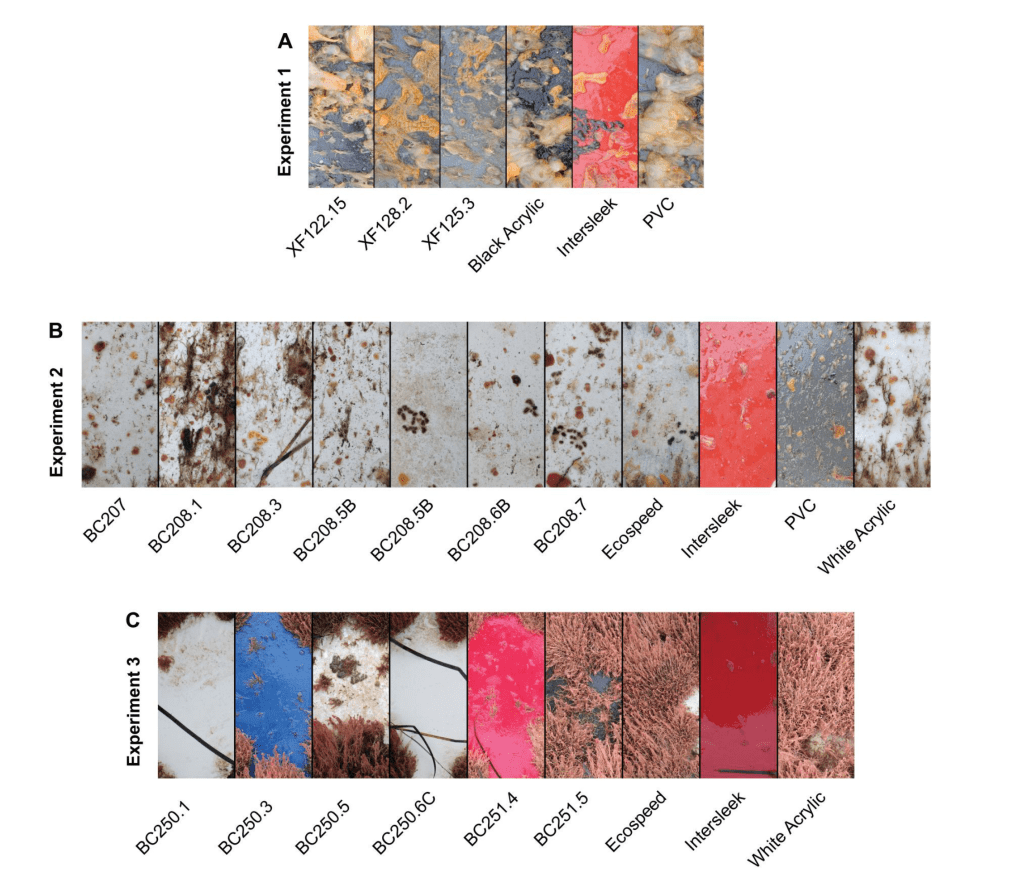
Special congrats to Ally Hunter who led the effort to get this study published. The experiments were spread over three years, conducted by the biofouling group, including contributions from Ally, Aaron, Kristyn, Kylie, Katherine, and Lexie. We field tested prototype coatings developed by our collaborator, GIT Coatings, Inc., and showed that by the final year, the coatings were able to reduce development of biofouling. The antifouling effect is probably based on making the coating surface slippery, making them much easier to clean off than uncoated surfaces. Such “fouling-release” coatings are a standard modern approach to producing an antifouling coating with lower environmental impacts. What makes the GIT coatings special is that they have higher hardness than typical, making them likely to be more durable than the relatively soft current fouling-release coatings on the market. In fact, our study is (we believe) the first study to document development of a hard fouling-release coating.
Hunter, A.T., Cogger, A.J., Boutilier, K., Curnew, K.H., Purvis, K., Trevors, A., and Wyeth, R.C. 2025. Development of marine antifouling performance in hard fouling-release coatings. Biofouling. Taylor & Francis. Available from https://www.tandfonline.com/doi/abs/10.1080/08927014.2025.2498027 [accessed 7 May 2025]. Alternate link for PDF access.
 Wyeth Lab