Great to see so many Wyeth Lab students, current and past, helping put on the truly impressive World Ocean Day program organized by Reg Cozzi and Leah Rogers of the StFX Biology Dept.
Ella Maltby

Upon completing my BSc in Biology at StFX, I went through the typical post-graduate crisis where I didn’t know what to do with my life. Thankfully, Russ took pity on me and I joined the Wyeth lab, primarily researching the effect of UV light exposure on biofouling organisms. I have also been involved with other projects including sea slug behaviour, crow behaviour, antifouling abilities of trout netting, and environmental sequencing of biofilm. I was accepted into the biology MSc program at StFX and will be looking at the effects of contaminants on lobster. I’m excited to be working with my co-supervisors, Russell Wyeth and Jim Williams, over the next 2 years.
Ella has been supported by the Province of Nova Scotia boat harbour remediation project and Nova Scotia Fisheries & Aquaculture
Amelia Mackenzie
I am originally from Sherbrooke, NS. After two years at Dalhousie, I transferred to StFX and completed my BSc in Biology with a minor in Development Studies in 2017. I joined the Wyeth Lab after graduation and worked primarily researching antifouling options, both commercially available products for aquaculture and UV technology with AML Oceanographic. I am currently a student in the accelerated nursing program here at X, but my love of biology and biofouling has kept me working part-time in the lab during my studies.
Amelia is supported by the StFX University Council for Research and Nova Scotia Fisheries & Aquaculture
Carmen Landry
I am a fourth year honours biology student at StFX, originally from Sydney, NS. This summer I am working on a project with Alex researching gene expression in the nervous system of Lymnaea. I am excited to get some research experience and learn from everyone in the Wyeth lab. After my undergrad, I’m hoping to take some time to travel and continue my education in hopes of pursuing a career in healthcare.
Carmen is supported by an NSHRF Scotia Scholars grant
Alex Young
I completed my BScH at Acadia University where I started as a Co-op student. I began my research career with an 8-month term at Agriculture and Agri-Food Canada where I found my interest in molecular biology. I explored this interest during my Honours at Acadia, developing a DNA barcoding protocol for preserved fungal specimens with a side project that involved annotating the mitochondrial genome of the fungus Phialocephala scopiformis. I am excited to now be at StFX solidifying my love for molecular biology in a whole new system – the gastropod nervous system! In the future, I hope to begin a career in private research or continue my graduate studies.
Alex is supported by an NSERC CGS-M and a Nova Scotia Graduate Scholarship
Hannah Stevens
I am a fourth year student taking a Joint Advanced Major in Biology and Mathematics. Working in lab this summer will be my first time doing research and I am very excited about it! Areej and I are studying Lymnaea snails and how they find food in still water and flowing water environments. I’m originally from Halifax and I’m looking forward to experiencing an Antigonish summer for the first time! After my undergrad degree I’m hoping to continue on to either a Master’s degree or medicine or both.
Hannah is supported in part by a NSHRF Scotia Scholars award and NSERC
Past Lab Members
Students and post-docs that have spent time, sometime, in the Wyeth Lab!
Undergraduates
Patrick O’Brien (research assistant)
Veronica Ells (research assistant, directed studies)
Rebecca Kennedy (research assistant)
Katy Grosicki (Honours)
Sara Livingstone (research assistant, directed studies)
Jonathan Schwarz (research assistant, directed studies)
Ian Carrigan (research assistant, directed studies)
Shauna Ryan (research assistant, Aqua 450)
JP Barry (research assistant, directed studies)
Grace Phillips (Honours)
Bailey Andrea (research assistant, directed studies)
Stephanie Clarke (Honours)
Marissa Webber (Honours)
Emily Kehoe (research assistant)
Tim Govare (research assistant)
Bridget Doan (Honours)
Jimmy Thomson (research assistant, directed studies)
Post-baccalaureates
Natika Bock (research technician)
Graduate Students
Kieran Murphy (MSc)
Natalia Filip (MSc)
Greg McCullagh (MSc)
Post-docs
Dr. Amanda Pustam
Lobster Baits & Behaviour
Lobster navigate using odours and water flow, and fisherman exploit this by baiting their traps to attract the lobsters. However, little is known about optimal bait types and the important odours found in plumes that attract lobster. Our goal is to build understanding of lobster responses to bait by:
- using laboratory experiments and underwater field video surveys to better understand lobster responses to natural food sources and bait
- analysis of larger scale lobster movement patterns relative to bait odour plumes generated by lobster traps
- analyzing chemical constituents of bait for their attractiveness to lobster
A primary driver behind this research to is help lobster fisherman attempting to improve the cost-effectiveness of their bait use.
Collaboration with Jim Williams and local lobster fishermen.
Neuroethology of Navigation in Gastropods
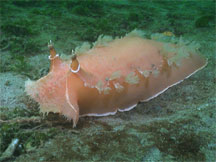
- The sea slug Tritonia Below: video shows slugs navigating towards and feeding on soft coral prey.
Navigation is a key behaviour performed by all motile animals. We work with gastropods because they are both amenable to a variety of experiments (both behavioural and neurophysiological) and they provide an interesting contrast to the navigation behaviours of other animals. Slugs and snails primarily relay on odours and water flow to guide their longer distance movements, although light and other cues (including possibly the earth’s magnetic field) also can play a role. Our long term goal is to understand how the different sensory cues are integrated together to produce the coordinated responses we see as the animals seek out food and possible mates, while avoiding predators.
We tackle this problem using several approaches:
-
- Modelling of navigation based on different sensory systems (including chemosensation, mechanosensation, and magnetoreception) and to explore the relative performance of different strategies in different sensory cue regimes.doi: 10.1093/icb/icv073 doi:10.3389/fnbeh.2010.00042
- Field observations and experiments using SCUBA and underwater video to characterize the sensory cues and navigational responses in sea slug Tritonia
doi:10.2307/4134598 doi:10.2307/4134599 - Laboratory experiments testing responses to different sensory cues (odour gradients, odours plumes in flow, etc.) in both Tritonia and the pond snail Lymnaea
doi: 10.1242/jeb.02164 doi:10.1080/10236244.2015.1123870 -
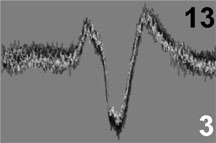
- A Tritonia neuron responsive to predator odour
Neurophysiological experiments exploring the connection between the sensory organs that detect odours, flow and other cues, and the motor neurons that control turning.
doi: 10.1242/jeb.02164
Collaborators: Ryan Lukeman, Jim Murray
Biofouling and Antifouling Coatings

A control plate (left) fouled by C. intestinalis vs a siloxane plate (right) with reduced fouling.
Biofouling, or the growth of organisms on man-made surfaces, affects many industries: food production, oil and gas, and shipping, among many others. As part of the StFX Centre for Biofouling Research, we are exploring novel non-toxic options for reducing biofouling, particularly focused on cold water marine habitats. The WyethLab’s role is primarily involved in field surveys of biofouling and field tests of candidate coatings that may reduce biofouling. We also partner with industry members to collaborative test commercial coatings.
Our projects include:
- environmental factors affecting invasive fouling tunicates; past collaboration with Dr. Cory Bishop, Aquaculture Association of Nova Scotia, DFO
- testing novel siloxane-based coatings; collaboration as part of StFX Centre for Biofouling Research
doi:10.1016/j.marenvres.2016.02.015 - testing ultraviolet light as an antifoulant; initiated by a collaboration with AML Oceanographic
- testing non-toxic antifoulant coatings with potential for use in aquaculture; past collaboration with Waycobah First Nation
- testing non-toxic hard fouling-release coatings which reduce attachment strengths of biofouling and increase durability; collaboration with GIT Coatings
 Wyeth Lab