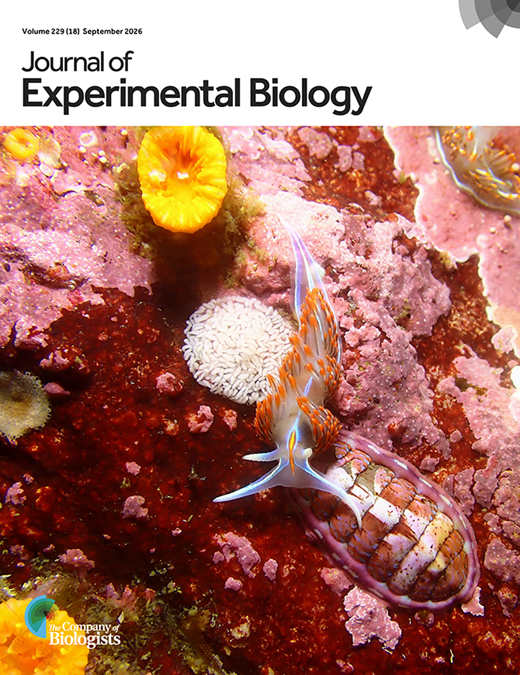
Congratulations to Lexy Reinhardt, three times over: she won the Outstanding Graduate Student Research Award during convocation ack in May, she published the first article from her thesis in the Journal of Experimental Biology, and snagged the cover art work for the journal issue as well, along with an Early Career Research Spotlight write-up.
Here’s what I had to say about the significance of Lexy’s thesis for the award nomination committee:
Reinhardt studied movement patterns relative to chemical and flow cues in the sea slug Hermissenda crassicornis. Reinhardt gathered data over 5 weeks using submersible video, recording 570 hours of video, with 311 slugs in the recordings. At the same time, she recorded locations of their prey and used current meters to record the water movement over the animals as they crawled. This combination allowed her to examine both major sensory cues the animals use to find food: water flow and chemical cues. The currents in their habitat are complex, involving longer term fluctuations in speed and direction from tidal flow and oscillatory flow generate by open ocean surge. Despite this complexity, Reinhardt’s data revealed the animals were using several strategies when responding to chemical cues in prey. When flow was less variable, they followed the flow that carried the cues. When flow was more variable, they seem to follow just chemical gradients, possibly generated by mixing that arises from the more variable flow.
The significance of this work lies in where it was collected. To our knowledge, this study is the only study to ever examine how any animal navigates through wave-affected subtidal environments using data collected in the field. In doing so, it revealed unexpected complexity in the strategies the animals appear to use (we expected higher flow variability to simply impeded navigation, not trigger a switch). Thus, the work extends our understanding of how gastropods (slugs and snails) move through the various environments they live, and extends our understanding (and the methods required to achieve that understanding) in wave-affected nearshore habitats. These holds a wide diversity of animals world wide, and Reinhardt’s thesis is pioneering the study of navigation in this complicated flow environment.
Reinhardt, A.M.D., and Wyeth, R.C. 2026. Navigational behaviour of the sea slug hermissenda crassicornis in natural wave-affected flow conditions. J. Exp. Biol. 229(18): jeb252174. doi:10.1242/jeb.252174.

