Author: Russell Wyeth

Tia Landry

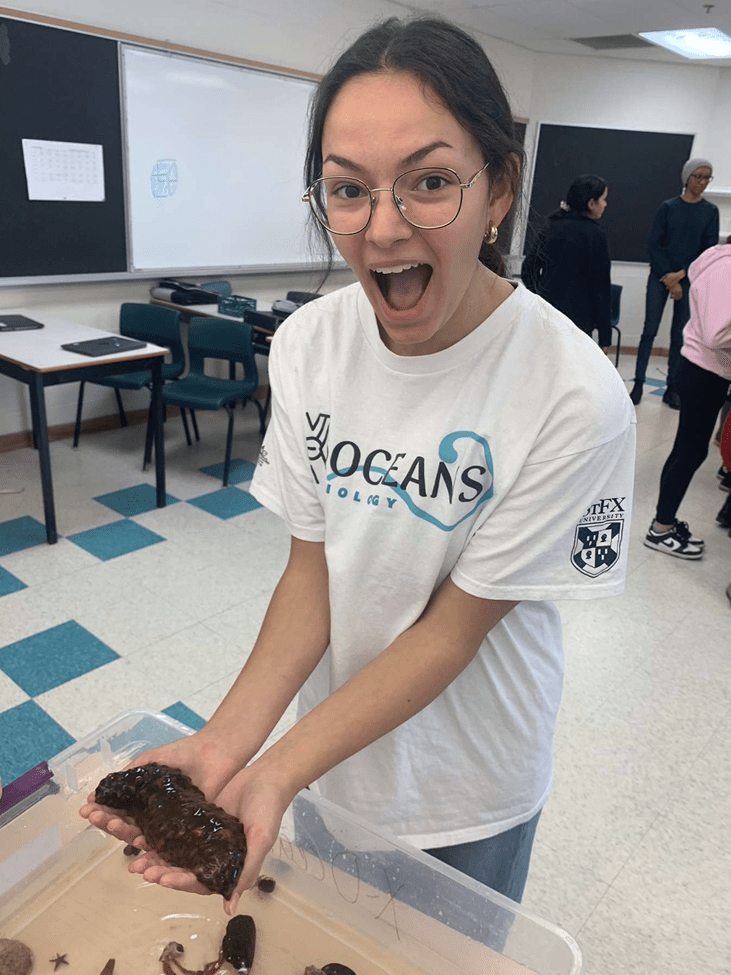
My name is Tia Landry, and I’m from Cape Breton, Nova Scotia. I’m going into my fourth year at StFX taking an Advanced Major in Biology and am also a co-president of the biology society on campus. This summer I’ll be returning for my second year in the Wyeth Biofouling Lab, where previously I contributed to research on marine biofouling settlement patterns and sustainable antifouling solutions. Our lab looked at environmentally friendly preventative measures including UVC exposure, graphene-based foul-release coatings, and non-toxic antifouling treatments, conducting fieldwork at various marine sites to document settlement behaviors. I am very excited to return to the lab this summer and soak in all that this experience has to offer.

Road Trip to CSZ

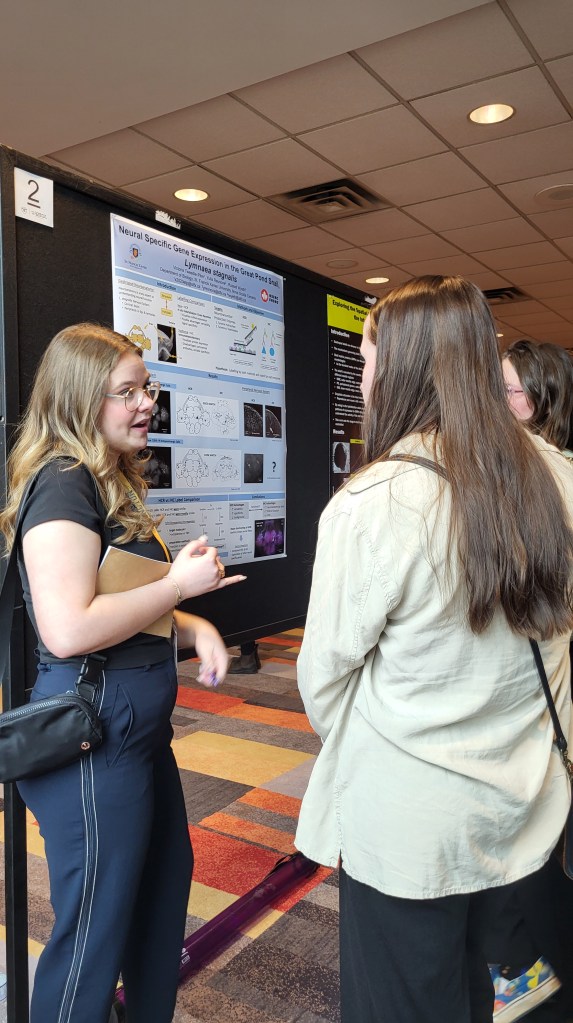
We just finished another good trip to the annual Canadian Society of Zoologists meeting. Moncton this year, which meant we could road trip it! Mike Murtaugh (MSc student) talked about his work exploring the consequences of a low levels of ultraviolet light on biofouling communities. Gavin Hiltz (Honours student) presented his work on developing a baseline behavioural survey of juvenile lobsters in the southern Gulf of St. Lawrence. Victoria Tweedie-Pitre (Honours student) presented her study using in situ HCR of neural-specific gene expression in the pond snail, Lymnaea stagnalis. Russell also presented on a closely related topic, collaborating with Roger Croll at Dalhousie on exploring octopaminergic neuroanatomy. Alongside the usual conference stuff (fun, interesting science) we snuck in a side trip to the spectacular Bay of Fundy.

Congrats Victoria and Gavin

Honours students Gavin Hiltz and Victoria Tweedie-Pitre are graduating today! Both did fantastic work on their theses over the last year. Gavin worked on developing a field survey of juvenile lobster behaviour with underwater video and Victoria worked on adding in situ hybridization chair reaction to our repertoire of techniques for gastropod neuroanatomy.

Research Technician Position Available

NOTE: THIS POSITION HAS BEEN FILLED!

We are looking for an enthusiastic, responsible, and hard-working individual to fill the position of Research Technician. The position will entail full time hours, blending farm visits, lab and office work for data compilation and analysis, and on-farm work to learn the operations of the new technology. Field work will travel to 4 other aquaculture sites across the Maritimes, with travel expenses reimbursed (including overnight stays, when needed). Office-based work will focus on data management and analysis, synthesis and writing a report on the research findings. Finally, throughout, a key aspect to project success is that the incumbent will learn the operation of these new technologies through on-farm work, both to provide important context for the research project and the final report, and also to facilitate communication with our study partners and the wider oyster aquaculture community.

Please see the full job description, preferred qualifications, and application procedure here.

Congrats Makayla

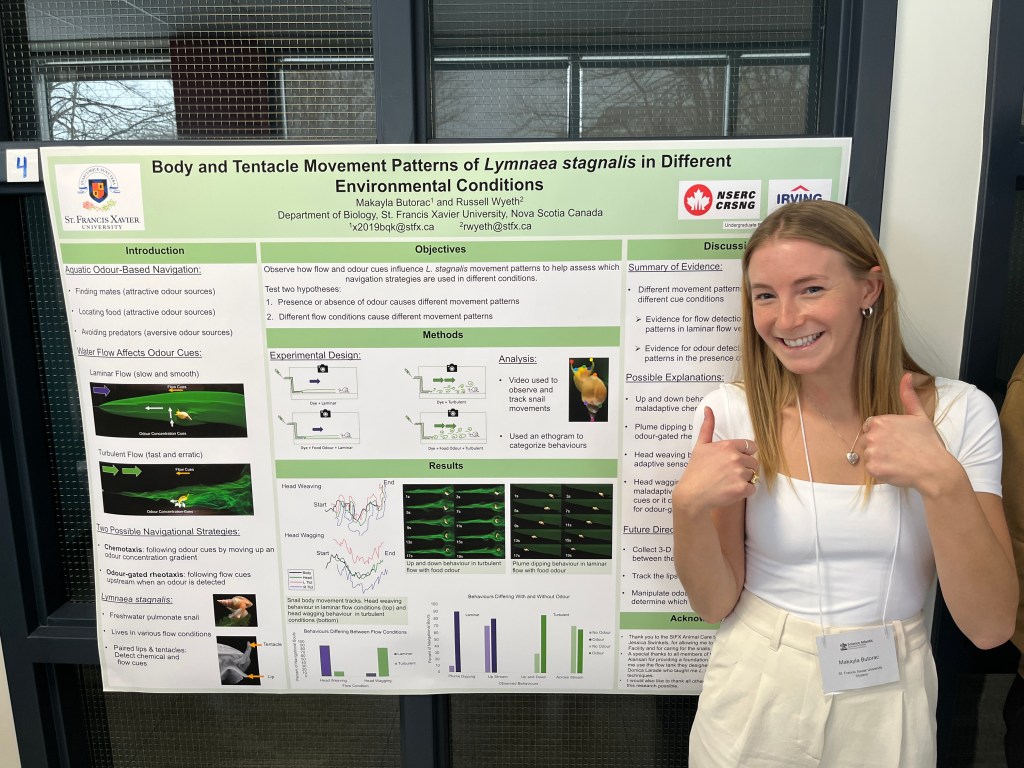
Kudos to Makayla, winning the Biology communication award for posters at this years Science Atlantic Undergraduate Biology Conference! Makayla’s Honours thesis focused on detailed descriptions and quantification of the movement patterns of the pond snail Lymnaea stagnalis. The overarching goal is to understand odour-based navigation strategies in the snails, and Makayla’s research lays the groundwork for experiments that can hopefully tease apart the strategies the snails may be using.

Michael Murtaugh

I am an international master’s degree student, originally from Long Beach, California, although most of my professional studies involving Marine Biology were accomplished in La Paz, Baja California Sur, Mexico. My main interests in Biology have always been evolution, macro-invertebrate taxonomy and ecology of biofouling assemblages. I have worked as an independent biofouling consultant for marine fish farms in Mexico, and now I am excited to start a new project focused on antifouling effectiveness of UV radiation. This antifouling technology may be the next big step towards cleaner and more efficient maritime transportation, but until then I will put it to the test and analyze its effectiveness in depth through my work in the Wyeth Lab at StFX.

M.Sc. Position to Study Juvenile Lobster Behaviour

NOTE: THIS POSITION HAS BEEN FILLED [updated March 2024]

Interested in aquatic animal behaviour, with practical implications for sustainable fisheries and marine conservation?

Interested in building expertise in a range of techniques, including field work (snorkeling or SCUBA), Remotely Operated Vehicle use, and machine-learning-assisted video analysis of behavioural observations?

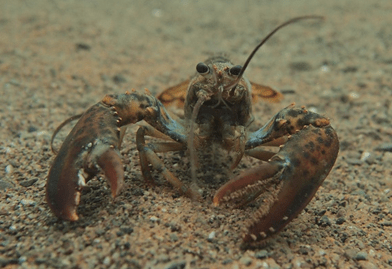
Our research is focused on building a more detailed understanding of juvenile lobster behaviour. We have developed tripod-mounted underwater camera systems that are effective at recording lobster behaviours in their natural habitat. The cameras provide unprecedented detail over durations far longer (up to 9 h of recording time) than has been achieved in past studies via SCUBA or other methods.  To date, we have focused on foraging behaviours of adult lobsters.  Our goal now is to shift our focus to juvenile lobsters behaviour and behavioural ecology.  Additional observations are planned using a Remotely Operated Vehicle (ROV).

Our primary goal is to establish a baseline data set of juvenile lobster behaviour.  The Department of Fisheries and Oceans has recently created a series of marine protected areas in the Southern Gulf of St. Lawrence. The Scallop Buffer Zones exclude scallop dragging, and are designed to protect juvenile lobster habitat. Our behavioural work will establish a baseline for on-going monitoring of juvenile lobsters into the future.  The behavioural data will be combined with additional population density surveys to assess the effectiveness of the marine protected areas, to help manage the lobster fishery, and to monitor the possible effects of climate change on the lobster population. 

Position start date: Jan 2024 or May 2024

For further information or to apply, contact Dr. Russell Wyeth: rwyeth@stfx.ca
Post-doc position available

Post-Doctoral Fellowship in Sustainable Anti-biofouling Technologies

  • Are you passionate about developing sustainable solutions to environmental challenges in trillion-dollar ocean industries?
  • Are you interested in developing interdisciplinary skills in collaboration with experts from industry and academia?

Memorial University of Newfoundland-Grenfell Campus and St. Francis Xavier University, through funding from the Ocean Frontier Institute (OFI), Mitacs and industrial collaborator Graphite Innovation and Technologies (GIT), are recruiting a Post-Doctoral Fellow to develop cutting edge anti-biofouling technologies for ocean industries in Atlantic Canada.

For more information and how to apply, please click here.

In the news

We’re in the news! Hakai magazine has a big article about the complexities of the bait issue in lobster harvesting. Our research on lobster foraging responses is highlighted as part of the varied efforts being put towards alternative bait adoption in the fishery. Hopefully this can help build some momentum towards switching to more sustainable bait options in the long run. Big kudos to the small army of students who have worked on the project over the years: Grace, Rachel, Michelle, Gavin, Laura, James, Aidan, Megan, Max, and Lia, and thanks to Moira Donovan for the article.