Author: Russell Wyeth

Juvenile Lobster Behaviour

Post #2 in a series from students working in the Wyeth lab this summer. Next up are Ryan Bergman, James Hanlon and Aidan McGowan, who are surveying juvenile lobster behaviour in the near shore environments around the southern Gulf of St. Lawerence

Our research focuses on s juvenile lobster abundance and behavior along the Scallop Buffer Zone. These protected zones along Nova Scotia’s northern coastline encompass pristine habitat for juvenile lobsters, which tend to settle in complex rocky habitats. Using underwater videography, we aim to explore the distribution of juvenile lobsters along the Scallop Buffer Zone. Additionally, we aim to use these videos to learn about the behavioral patterns of juvenile lobsters in the presence of bait. 

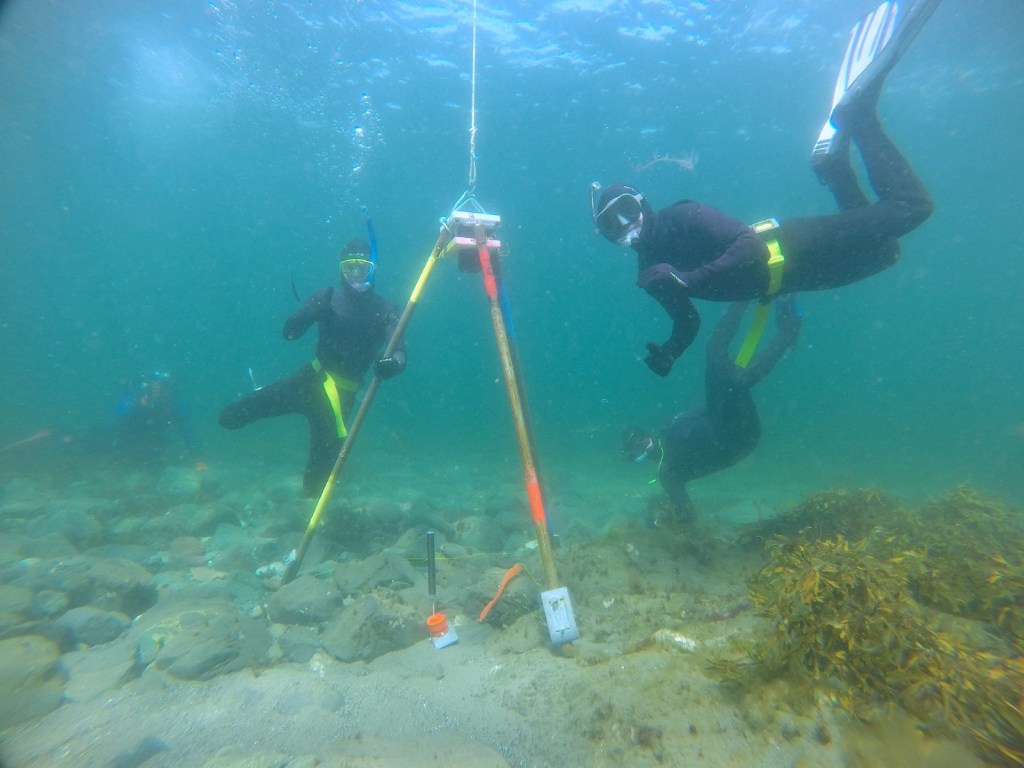
After selecting a beach to survey for lobsters, we head into the field and setup our cameras. To position them in the water, the cameras are placed on tripods made from metal poles roughly 2 meters tall. We then carry them into the water, attach buoys to the head and leg poles, and swim the tripod out as it floats in the water. In wetsuits and snorkeling gear, we search for ideal filming locations that lobsters may settle – for example, near the edges of seaweed and over rock piles. 

Filming over four hours of footage each day, we analyze our video data by first counting and measuring the size of lobsters. This allows us to identify habitats that juvenile lobsters frequently use and find beach sites that provide such favorable conditions. Using this contextual data, we will then document the behaviors of the juveniles as they are drawn out of their shelters with bait. This will us to classify how juvenile’s behaviour varies across different habitats and population densities. 

Victoria Tweedie-Pitre

My name is Victoria Tweedie-Pitre, and I am a recent graduate from StFX with a Joint Honours in Biology and Chemistry. I am so excited to be working for a second summer in the Wyeth Lab where I focuses on exploring the intricate neuroanatomy of the great pond snail, Lymnaea stagnalis. Using cutting-edge techniques such as in situ Hybridization Chain Reaction, I categorize and map different neuron types based on their association with neurotransmitter synthesis. I have always had a passion for exploration and love for marine biology, and I am excited to continue channeling this enthusiasm into my research. After completing my work here, I am returning home to the Northwest Territories to engage in a low arctic terrestrial ecology project before pursuing a master’s degree. I am incredibly grateful to be a part of the Wyeth Lab, and I am eager to continue developing skills that will be invaluable throughout my career and life.

Hermissenda field behaviour

Post #1 in a series of posts from students working in the Wyeth lab this summer. First up is Lexy Reinhardt, who is collecting data for her MSc thesis focused on the navigation behaviour of the sea slug Hermissenda crassicornis. Take it away Lexy…

Close-up of Hermissenda crassicornis, the long-horned nudibranch.
Example of field video data capturing Hermissenda behaviour

Dr. Wyeth and I are currently at the Bamfield Marine Science Centre collecting underwater videos of sea slugs in their natural habitat for my MSc thesis. My ongoing research project focuses on the behavior and navigation of Hermissenda crassicornis, commonly known as the thick-horned nudibranch. 

For the past three weeks, we have undertaken daily SCUBA dives to deploy and recover underwater video cameras mounted on tripods. These cameras are strategically placed to capture video of the nudibranchs as they move through their natural environment.

The high-quality video, the likes of which have never been captured before, will enable us to conduct detailed analyses of movement patters and also contribute to the broader understanding of Hermissenda crassicornis behaviour. Though we are still in the early stages of data collection, we’ve already begun to observe some intriguing patterns and behaviours! 

In the coming weeks, we will continue our daily dives and video recordings. Our goal is to gather a comprehensive set of videos that will allow us to identify specific navigational trends and behavioural characteristics associated with different flow environments and chemical stimulus sources. 

We are thrilled with our progress so far and look forward to sharing more detailed findings as our project advances. Stay tuned for further updates!

Yulia Reunova

 I am Dr. Yulia Reunova and I have been working as a research associate in the laboratory of Dr. Russell Wyeth for the past two years, studying the neuroanatomy of the great pond snail, Lymnaea stagnalis, using Immunohistochemistry and in situ hybridization chain reaction, and combining the two to label target RNAs and proteins in the central and peripheral nervous system. My previous experience lies in the field of reproductive biology, using molecular biology methods and scanning and transmission electron microscopy. My passion is mastering new and challenging methods.

Ryan Bergman

I am an international master’s student joining the Wyeth Lab from sunny South Florida. My research involves the use of underwater videography to study juvenile lobster abundance and behavioral patterns along protected waters on Nova Scotia’s northern coastline. Earning my bachelor’s degree from the University of Florida, I studied disease ecology and physiology in a variety of marine invertebrates through research experiences. After graduating in 2023, I followed the field of crustacean biology to the University of Maine, where I first interacted with the American lobster industry and researched settlement through an internship with The Lobster Institute. I am excited to research lobsters in their early life stages here in Nova Scotia and contribute to the dynamic team at the Wyeth Lab at StFX.

Lexy Reinhardt

In the Wyeth Lab, my research focuses on the field behavior and navigation of the captivating sea slug, Hermissenda crassicornis. I earned my undergraduate degree in Marine Biology from the University of British Columbia in 2023, where I gained fieldwork skills at the Bamfield Marine Sciences Centre. Throughout my undergraduate journey, I collaborated with various organizations and labs, including Project Seahorse, iSeahorse, the O’Connor Lab, the Beaty Biodiversity Museum, the UBC Aqua Society, the UBC Women in Science Club, Women in Ocean Science, the Research Experience Program, X-Oceans Outreach, and the Sustainability Committee. As an enthusiastic diver since 2011, I have since gained my scientific diving certification, which complements my current project of capturing underwater videos of sea slugs in their natural habitats near Bamfield, British Columbia. Beyond my research, I have a deep passion for the arts, often dedicating my weekends to underwater photography and pottery.

Lauren Pictou

My name is Lauren Pictou, and I am going into my fourth-year at StFX. I am from Yarmouth, Nova Scotia and at StFX I am pursuing an honours degree in biology. Last year I began my research journey in the Wyeth lab, using Immunohistochemistry and in situ Hybridization Chain Reaction I mapped several types of neurons in the brain of Lymnaea stagnalis. After acquiring some unexpected results, I decided to focus my honours research on exploring the neurons which express choline acetyltransferase, the enzyme that synthesizes the neurotransmitter acetylcholine. I am very excited to continue to develop my hands-on skills and learn more biology!

Tia Landry

My name is Tia Landry, and I’m from Cape Breton, Nova Scotia. I’m going into my fourth year at StFX taking an Advanced Major in Biology and am also a co-president of the biology society on campus. This summer I’ll be returning for my second year in the Wyeth Biofouling Lab, where previously I contributed to research on marine biofouling settlement patterns and sustainable antifouling solutions. Our lab looked at environmentally friendly preventative measures including UVC exposure, graphene-based foul-release coatings, and non-toxic antifouling treatments, conducting fieldwork at various marine sites to document settlement behaviors. I am very excited to return to the lab this summer and soak in all that this experience has to offer.

Road Trip to CSZ

We just finished another good trip to the annual Canadian Society of Zoologists meeting. Moncton this year, which meant we could road trip it! Mike Murtaugh (MSc student) talked about his work exploring the consequences of a low levels of ultraviolet light on biofouling communities. Gavin Hiltz (Honours student) presented his work on developing a baseline behavioural survey of juvenile lobsters in the southern Gulf of St. Lawrence. Victoria Tweedie-Pitre (Honours student) presented her study using in situ HCR of neural-specific gene expression in the pond snail, Lymnaea stagnalis. Russell also presented on a closely related topic, collaborating with Roger Croll at Dalhousie on exploring octopaminergic neuroanatomy. Alongside the usual conference stuff (fun, interesting science) we snuck in a side trip to the spectacular Bay of Fundy.

Congrats Victoria and Gavin

Honours students Gavin Hiltz and Victoria Tweedie-Pitre are graduating today! Both did fantastic work on their theses over the last year. Gavin worked on developing a field survey of juvenile lobster behaviour with underwater video and Victoria worked on adding in situ hybridization chair reaction to our repertoire of techniques for gastropod neuroanatomy.