News

Summer research recap: a trip down under

This slideshow requires JavaScript.

Russell spent most of July in Australia doing all sorts of science –  snails, medusae, giant tritons,  and Crown-of-Thorns seastars  (and some fun encountering some southern biota outside of the lab, also).   Much of the time was spent catching up with folks in the Cummins lab at the University of Sunshine Coast – working on manuscripts and providing advice to new students on their behaviour experiments.   The International Congress of Neuroethology was also held in Brisbane, and our poster shared recent work by MSc students Areej Alansari and Alex Young on Lymnaea as well as earlier work on Tritonia that involved a whole crowd of past students.

Russell C. Wyeth, Areej Alansari, Shelby Brown, Jane Fletcher, Carmen Landry, Ella Maltby, Kieran Murphy, Patrick O’Brien, Hannah Stevens, Alex Young.  2018. Neuroethology of chemosensory-based navigation behaviour in the aquatic gastropods Tritonia and Lymnaea. Internation Congress of Neuroethology, Bribane, Australia. Poster Link

There was also time to sneak in  trips to the Australian Institute of Marine Science to give advice on flow tank design and the new jellies research facility, led by Dr. Kylie Pitt from Griffiths University and developed as a partnership with the Gold Coast SeaWorld, to discuss experiments and analysis of behaviours in cnidarian medusae.   Maybe new collaborations or projects in the future…

Publication! Opalescent nudibranchs marching northwards.

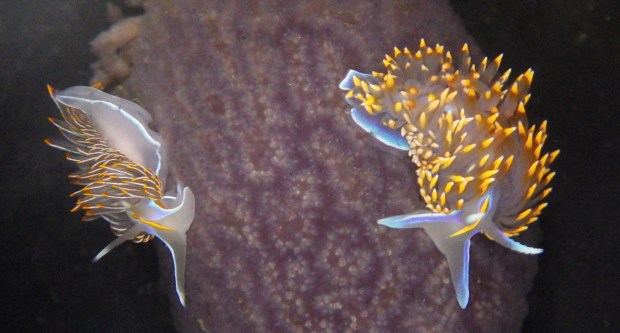
Congrats particularly to Kathryn Milligan, Nola Sheets and Emily Merlo, who started this off as course project at Bamfield Marine Sciences Centre in the 2016 Marine Ecology class taught by Dr. Chris Neufeld and Tao Eastham.  We were able to show that there were two species of Hermissenda present in Barkley and Clayoquot Sounds on Vancouver Island.  One is supposed to be there,  while the other is supposed to be in southern California.  Telling them apart is fairly straight forward, when you know what to look for: northern Hermissenda crassicornis have white striped cerata (sticky up bits) while southern Hermissenda opalscens have white tips but no stripes on their cerata. With the help of Dr. Ángel Valdés and Ka’ala Estores-Pacheco as well as the Barcode of Life group, we confirmed the original  morphological data with genetic analyses.  The question now, of course is why?  Perhaps climate factors?  Other species were also found far further northwards than normal that year…

Check out the lay summary here, or the full publication here:
Merlo, E.M., Milligan, K.A., Sheets, N.B., Neufeld, C.J., Eastham, T.M., Estores-Pacheco, A.L.K., Steinke, D., Hebert, P.D.N., Valdés, Á., and Wyeth, R.C. 2018. Range extension for the region of sympatry between the nudibranchs Hermissenda opalescens and Hermissenda crassicornis in the northeastern Pacific. FACETS 3(1): 764–776. doi:10.1139/facets-2017-0060.

Congrats to WyethLab alumn, Jane Fletcher – accepted into an MSc program at the University of Calgary.

Jane will be studying novel ways to reduce methane gas production by cows, based on viral microbiome work.  That seems a far cry from the sea slug navigation behaviour she studied in the WyethLab.  But she has already been using some of the same analysis and data management tools learned with the slug work in her new lab.  A great example of how research can take you down unexpected paths.

Congrats! Ella Maltby just successfully defended he MSc thesis proposal!

Just 6 months into her program, Ella has developed an ambitious plan to study the impact of contaminants on lobster. Her fieldwork has already started, which meant some very early mornings on some local lobster boats recently. She got a moment to rest after the proposal defense, but then it was right back to work on some extra sampling decided on during the committee meeting.

almost the whole WyethLab

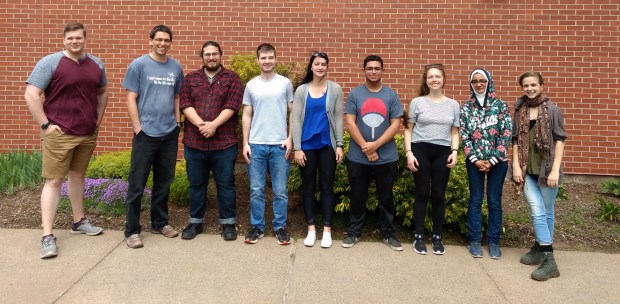
Here’s almost the whole crew – travel schedules didn’t mesh so we are unfortunately missing Katerina and Sophie, but otherwise we’re all in the line!  From left-to-right…

And missing are…


2018-06-12 14.23.35

WyethLab, going with the flow

Presenting at CSZ in St. John’s

We’ve just wrapped up a great week at the annual meeting of the Canadian Society of Zoologists. Alex Young and Areej Alansari presented their snail research – on neural gene expression and navigation behaviour, respectively. Ella Maltby presented her work from the last couple years on ultraviolet light as an antifoulant. And Russell went in a new direction, sharing research on crow behaviour conducted by the 2015 and 2016 students in his 4th year Animal Behaviour course.

milestones, news, and more

Lots of congratulations to share…

Carmen Landry submitted the final version of her Honours thesis.

Amelia MacKenzie was awarded Holly E. Bartlett Memorial Bursary (in the StFX News)

Ella Maltby and Areej Alansari presented their MSc work in a split seminar to the Biology Department to widespread acclaim!

And RCW and Mar Wonham’s article on teaching the scientific method also was shared by StFX News (along with some nice comments from Carmen and others!)

Ella Maltby

Areej Alansari

Wyethlab at Student Research Day

image2

Ella and Carmen

Unfortunately, I had to miss Student Research Day this year while travelling in Europe.  But the WyethLab was well represented!  Carmen Landry won the top award for oral presentations sharing her work on reference genes for qPCR in snails.  Although they didn’t compete for awards, I’m reliably informed that both Ella Maltby (poster) and Amelia MacKenzie (talk) did a great job with their presentations on antifouling research.